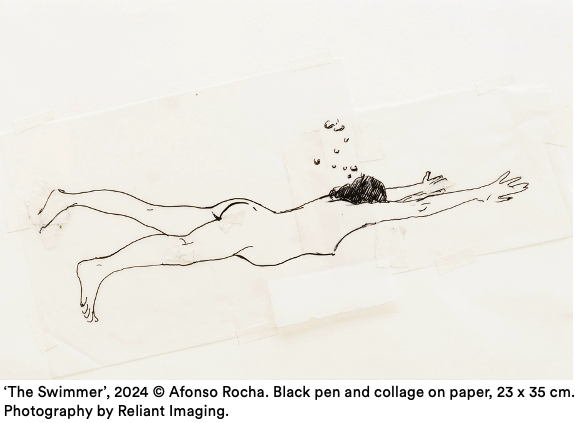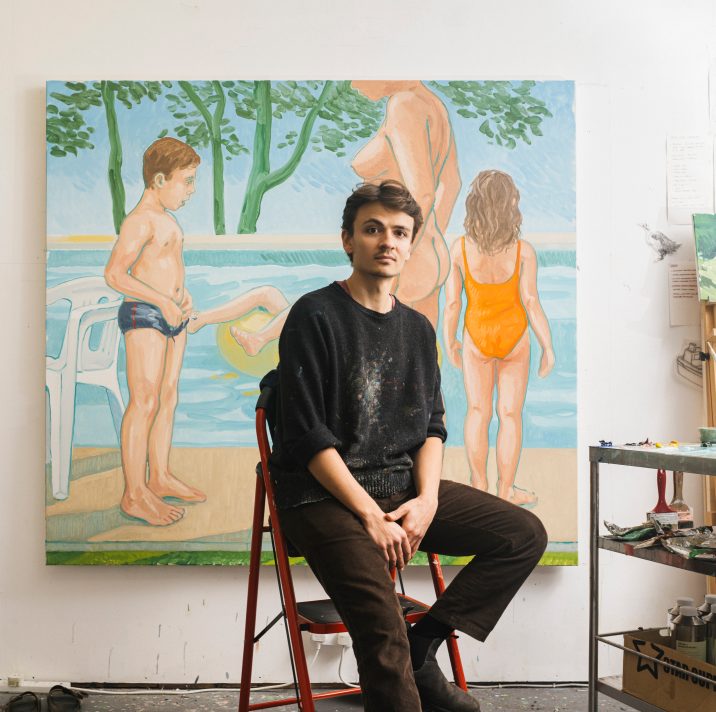
Studio Portrait © Afonso Rocha. Photography by Reliant Imaging.
Afonso received a £6,000 prize to help establish a studio space as he transitioned from a Masters student to practising professional artist.
ACS spoke to Afonso about his work, the processes and inspiration behind his creations and how the Prize has helped his practice develop.
How would you define your work in three words?
Charged, intimate and melancholic.
What medium do you mainly work with and why?
I mainly use oil paint; it is an extremely flexible medium and it allows me to obtain substantially different results, from something very thin and watery, to the heaviest textures. I also quite like the fact that oil demands its own time. You cannot rush it, you cannot force it to dry, it gives you time to think and contemplate, time to adjust and erase if need be. To put it in different words, oil painting is a bit like having a conversation; you cannot just say whatever you mean, you have to stop and listen before you reply.
Where do you find most inspiration for your work?
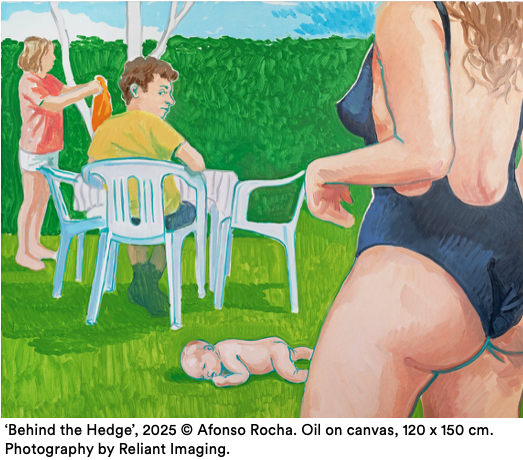
My work tends to delve into personal subjects and reflections. It is, to an extent, a way of exploring ideas and concerns that, at some point in time, feel relevant or urgent to me. I make it a constant exercise to look around, to see how we behave, how we think, how we relate to each other. My practice is therefore, for lack of a better definition, a continuous record of my contemplations, fixations and anxieties.
Consequently, inspiration tends to come from examining the things that are closer to me. From my childhood, my adolescence, my present life, from my family and those I meet, from stories I hear or thoughts that just stay stuck in my mind.
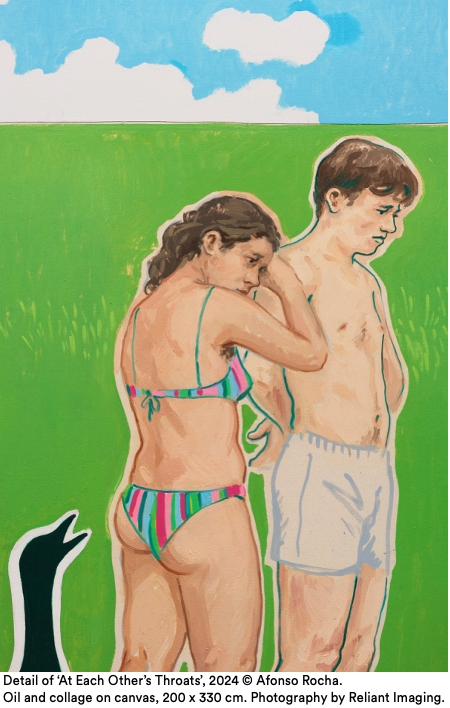
Sometimes there is a complex idea behind a painting, but at other times it just spontaneously develops from an image I like or an action I find to be emotionally complex.
Take us through your working process.
My process often starts with collecting. I collect all sorts of visual and conceptual material, spanning from personal photographs and memories to Old Master paintings, literature, social media, cartoons, erotic representations, amongst other things. I draw these references and use them as puzzle pieces to slowly build scenes that translate my emotional and intellectual wanderings.
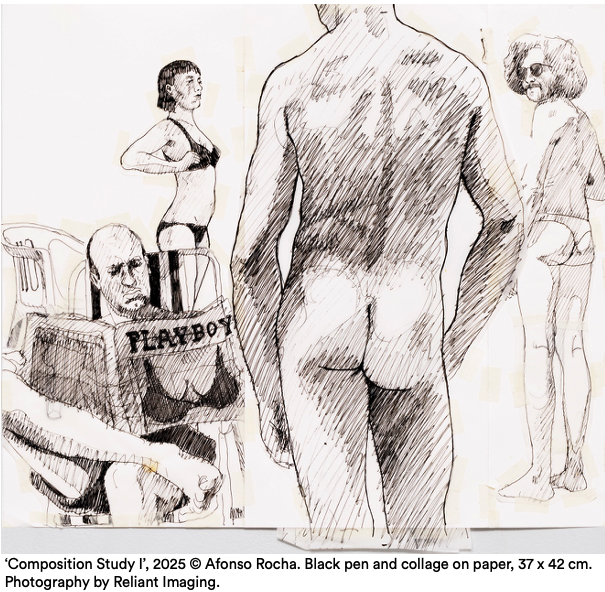
After a lot of back and forth trying to find the right combinations, I finally end up with a set of different compositions. One by one, I start refining them, as well as choosing the right canvas size and adjusting them to the large format. Unfortunately, not all compositions make the cut, and some end up being left behind: maybe to be picked up later on. Then the process of painting begins, I am quite methodical and work on a subject at a time, starting with the most important figures first and moving then towards the backgrounds and all the other objects or clothing that define the colour palette of the painting.
Even though I am a surprisingly organised painter, the process of creating an image is never a passive or reliable one. As I said before, it is always a conversation, a sort of fistfight between what I want the painting to be and what it forces me to do. Needless to say, the result is never even close to my first intention… but that is, I believe, the most enjoyable part.
Can you remember the first work of art that you created? What was it and why was it so memorable?
I am not sure I know what making a ‘work of art’ really means or when I made my first one, if I ever did. Since I remember, I have always liked painting and drawing.
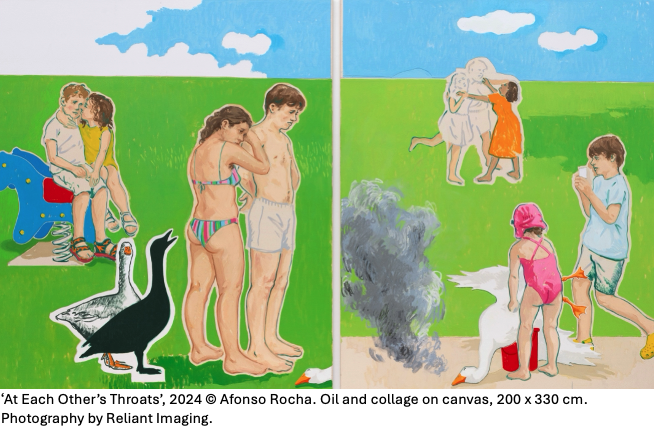
At home it was something normal, like playing or watching TV. I grew up doing it and people around me seemed to think I was good at it, so they incentivised me. Then, at some point, I started to become very self-critical. I would get annoyed at the fact that my dad or my friends were better than me, and that would make me very frustrated. My relationship with drawing and painting quickly became more complex.
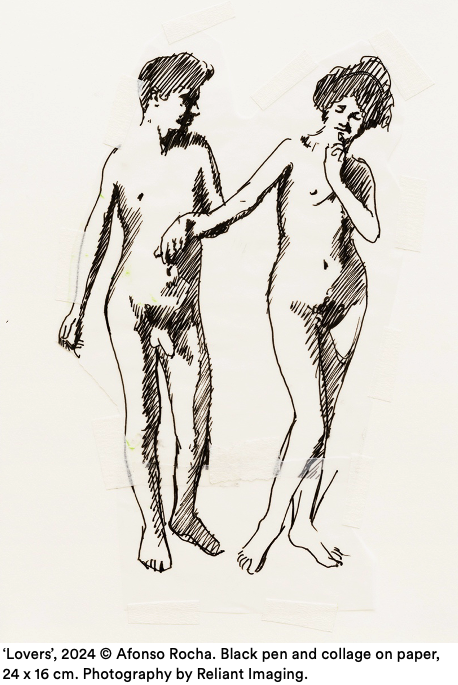
A sort of love-hate relationship fuelled by my willingness to do better. I do remember, however, the first time I created something that I felt was a proper artwork, in the sense that it demanded real commitment and creativity. It was a set of coloured pencil drawings depicting different people and creatures in a circus. I was quite young and remember being really proud of it.
What did it mean to you to win the 2024 ACS Studio Residency at City & Guilds? How did you use the prize money? How did that help you as an artist?
I was beyond excited with being awarded the ACS Studio Residency Prize at the end of my Masters. It was a big acknowledgement of my work, of its quality and presence.
The prize money allowed me to rent a proper studio in East London and immediately get back to work without having to worry too much about the financial burden that being an early career artist often entails.
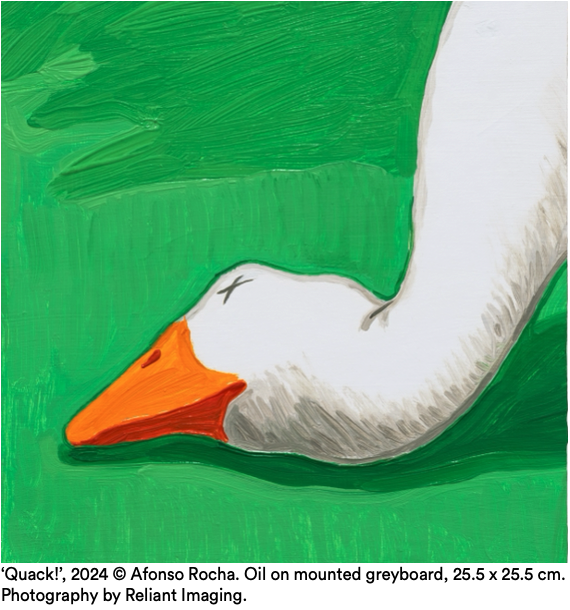
That meant I could focus on my painting completely and really try to make my best work. Even though the first few months were still filled with doubt and uncertainty, I think this past year was extremely important in my development as an artist. Thanks to the Prize, I was able to continue to work on large scale and produce a whole new body of work that I am quite proud of.
What do you have coming up over the next year?
I am now preparing for my biggest London show to date, opening on the 2nd of June with The Tagli, in Great Titchfield Street, near Oxford Circus.
I am presenting a new body of work, produced between 2025 and 2026, including paintings and drawings across different formats.
I am particularly excited for this one!
To view more works by Afonso Rocha, visit his website here.