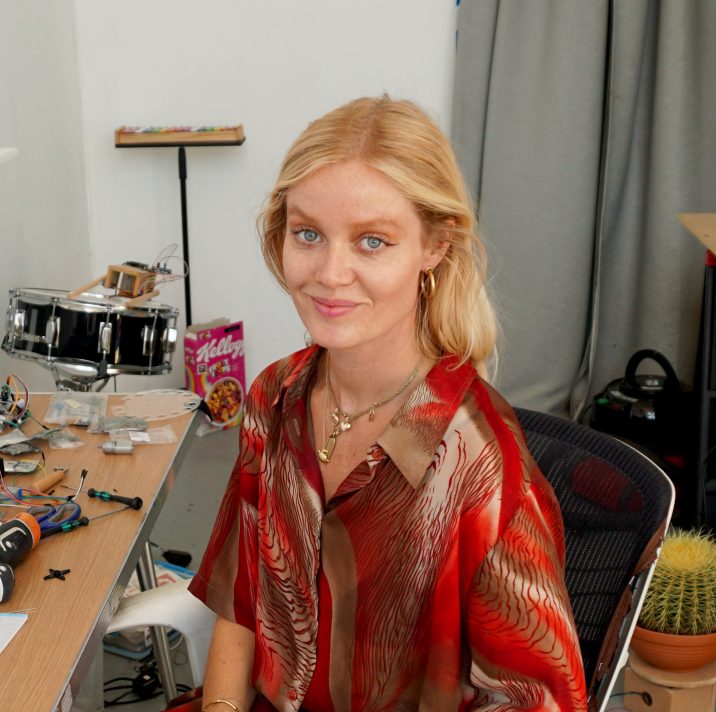
Portrait of Clara Hastrup © Clara Hastrup. Courtesy of the artist.
Have you always worked in multiple media?
Yes, my work includes sculpture, photography, video and sound, often combining analog and digital technologies.
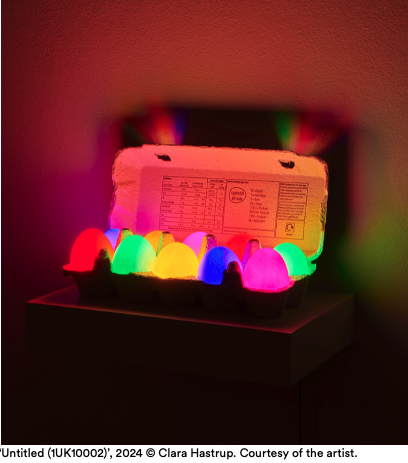
It really depends on the idea; one idea can also exist in different media, like an image becoming a sculpture or a sculpture becoming a video.
The differentiation is not so important to me, it is more about the generation of meaning when you shift from one thing to another that interests me.
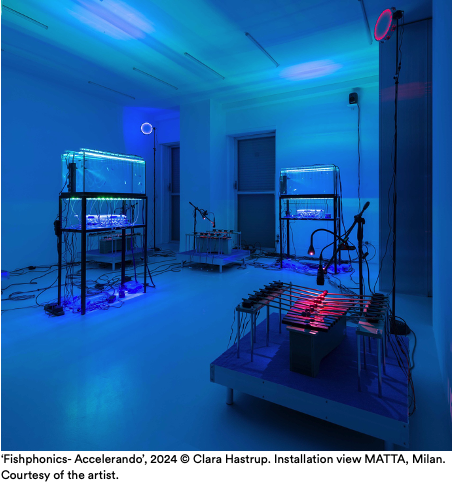
I’m interested in the concept of sculpture as a system where many disparate parts come together and interact in different ways.
I gather inspiration from nature, books, travelling and my everyday surroundings.
Visiting the site where an exhibition will take place can also serve as inspiration for the work. I like to have an architecture or context in the back of my mind to respond to – it is important when working in multiple scales.
Take us through your working process.
I accumulate a lot of stuff in my studio, and I gather a lot of information about topics that interest me.
I don’t start out with a finished idea of the work in mind. It often starts with a set of rules or a kind of logic I want to explore and work with.
Objects and materials pile up and circulate over time. I consider my working process as generative as I need to constantly feed it new information, images, materials and technologies to keep it moving forward.
I often work on multiple ideas simultaneously. When they start to overlap and connect is what really excites me. In that sense, the process is often unpredictable and not very linear. I also like to go back in the process and imagine if a work had taken a different direction – so that can also serve as a starting point.
I work best in complete privacy, and the studio, for me, is a really important place to think and try out ideas – and failing ideas.
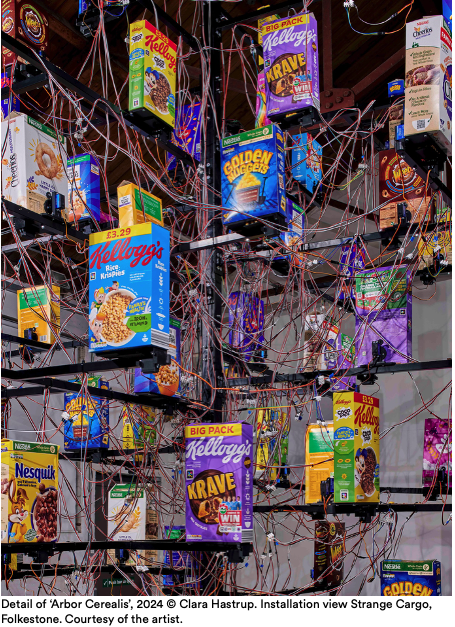
My work is not only financially demanding material-wise, but also time-consuming, labour-intensive and requires a lot of space to exist. Due to its nature I’m extremely dependent on having a studio. It is a vital space where I can devote all of my time researching, brainstorming, learning and experimenting with ideas and executing works. Through the studio and these projects, I have been able to continue developing my work.
It was a great honour receiving the ACS Prize, and it meant that I was guaranteed the security of a studio for a year at an exciting, but unstable time when I had just graduated.
Since winning the ACS Prize, how has your practice developed?
I have had time to work on ideas for new works. Working primarily in sculpture is often materially heavy and requires a lot of intensive labour. The prize really contributed to the space and time I needed.
It really gave me peace of mind after graduating. The stability from having a studio was invaluable for me to continue experimenting and working on multiple scales.
How are you looking to continue your development following the assistance of the ACS Prize What do you have coming up (e.g. exhibitions, residencies).
The next year will be busy for me. I have a number of commissions and exhibitions lined up. All of which are the result of the time the Studio Prize afforded me to focus and keep working last year.
In terms of the work itself, I never know what is next – it is quite unpredictable, and I also like to keep it open for as long as possible.
The group show will seek to address and expand upon certain questions such as ‘What does it mean to cultivate a sense of neighbourliness nearby and from afar?’ and ‘In what sense can love act as a public force, capable of countering social, ecological, economic, and political injustices?’ in the hope of sharing the concept of ‘across, with, and nearby’ with participants. Find out more information about the exhibition here.
To view more works by Clara Hastrup’s, visit her website here.