
'Self Portrait in a Mirror', 1950-57 © The John Bratby Estate. Oil on board. 122 x 121.7 cm. Image courtesy of Manchester Art Gallery, UK/ Bridgeman Images.
John Randall Bratby was born in Wimbledon. He did not show an aptitude for art until he was seventeen when his teacher, Harold Watts, recognised his potential in several sketches of boxers he had completed. Encouraged by Watts, he enrolled at Kingston School of Art in 1947.
He remained there until 1950 and, a year later, started at the Royal College of Art, where he studied until 1954.
Whilst studying there, he lived an unsettled, often wild lifestyle, sometimes begging and sleeping rough in Hyde Park. His work regularly reflected this lifestyle. Inspired by the realism of Sickert, he painted the seedier aspects of his life and surroundings in a correspondingly crude manner.
‘Regatta Boats’ © The John Bratby Estate
In 1953, Bratby married fellow student Jean Esme Oregon Cooke, who later went on to become a successful painter in her own right. In the following year, he had the first in a series of solo exhibitions at the Beaux Arts Gallery and he exhibited for the first time at the Royal Academy.
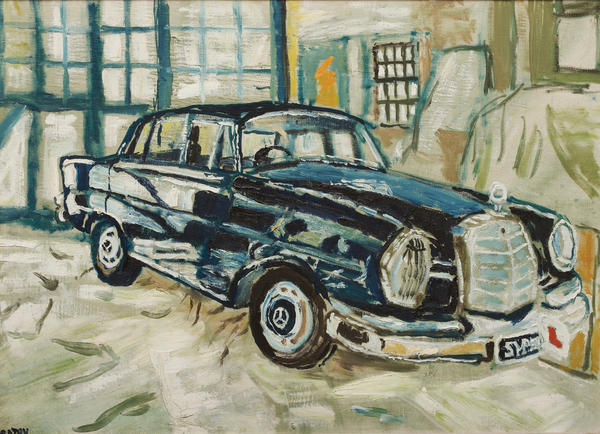
‘Mercedes – the artist’s car’ © The John Bratby Estate
Bratby became disillusioned with painting throughout most of the 1960s and abandoned art to concentrate on writing. However, by 1967 he was painting again, when he began a series of portraits which eventually numbered over 1,500 works. Nearing the end of his life, he tended to work frenetically although his paintings rarely lived up to the mastery of his earlier works. His work is represented in the collections of the Tate and the Victoria and Albert Museum in London, and the Museum of Modern Art in New York.
Can you provide a brief overview of the artist and their work?
Holly R: Bratby was very wrapped up and obsessed with my mum – Patti was his muse – and they created their exclusive own world together.
What role did you play as part of the artist’s estate?
Holly R: I inherited the [Artist’s Resale Right] royalties directly from my mum, Bratby’s wife, Patti.
I am here if anyone has any questions, but [Bratby’s] works are well respected around the world to the point that I do not really need to actively promote him.
He was a prolific artist whose works appear in major collections both across the UK as well as abroad.
Holly S: My role was that I had Power of Attorney over Patti and her finances. She asked me to guide her and help her in her old age. She was my mother’s cousin, so I was glad to give her this support.
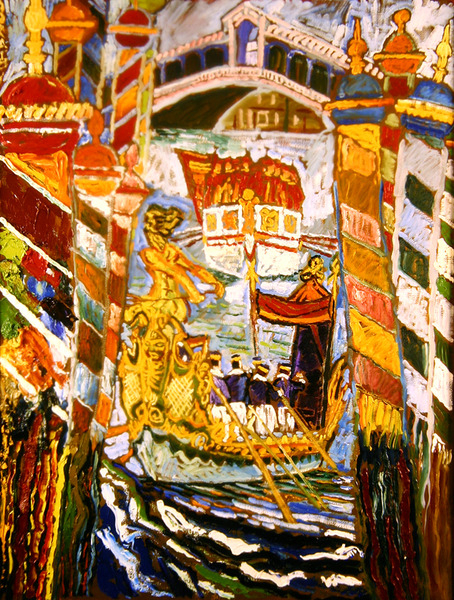
‘Venice Washing’ © The John Bratby Estate
How do you think that intellectual property rights such as copyright and ARR help you and the estate?
I am a musician, and whilst I have a few regular residencies, work, especially over the COVID-19 pandemic has been for me, and most artists throughout the world, more than a little erratic. There are times over the last eighteen months where I have relied on the royalties to pay my rent.
It is not overstating when I say that the [Artist’s Resale Right] royalties have really made my life so much better.
As a musician, I know how important intellectual property rights are to creators. Seeing and benefiting from the increasing value of Bratby’s work means that I have experienced the benefit of ARR first hand. It really has taken a lot of pressure off me.
It is so important that living artists and their beneficiaries are able to enjoy a small percentage of the resale value of their work.
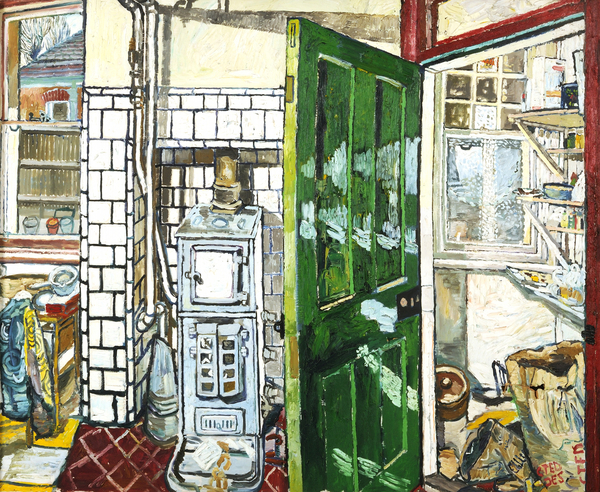
‘Kitchen II’ © The John Bratby Estate
Patti was in a nursing home in Bexhill-on-Sea, and the revenue paid for occasional outings with a caregiver to local shops and restaurants, with the use of a wheelchair taxi. Of course, the funds also helped to pay for the monthly cost of her nursing home. Patti always appreciated the royalties sent in connection with the sale of John’s paintings. She often wanted to let the auction houses and galleries involved know just how useful the royalties she received were.
Now that Patti has passed away, I can see how much of a boost the royalties give to her daughter Holly Roberts. Holly (we were both named after my grandfather, but that’s another story) is a jazz pianist and the income, although it’s not a huge amount of money, makes a significant difference to her lifestyle. She is more relaxed about her future now. It also means that John Bratby can bestow gifts on her from beyond the grave.
Holly R: Organisations such as ACS and the support that you offer are immense help to estate’s like Bratby’s. Knowing that you are there to offer advice and assistance should I have any questions is a relief.
Holly S: I appreciated the way ACS always presented clear and timely accounts, both to me and Patti, and made sure the royalties were paid directly into Patti’s bank account. It made things much easier.
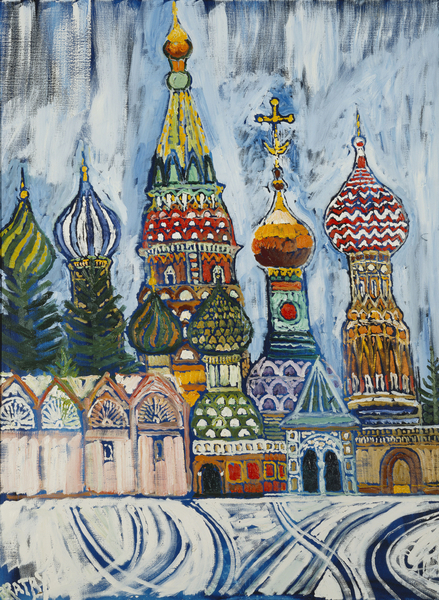
‘Moscow’ © The John Bratby Estate