
David Gardner in his studio.
How would you define your work in three words?
Colourful, introspective, figuration.
What medium do you mainly work with and why?
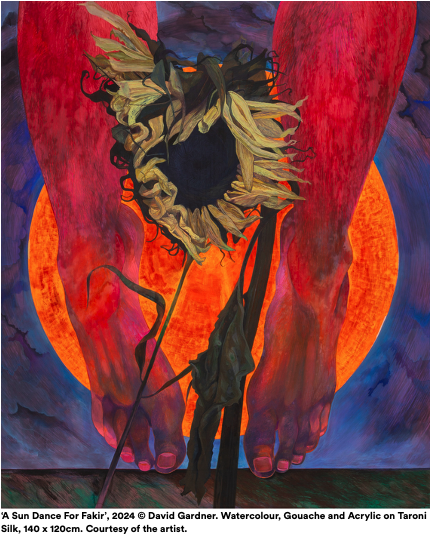
For a long time, I was working exclusively with dry medium – charcoal, pastels, colour pencils etc. Over the last 3 years, I have been painting with watercolours, gouache and egg tempera on stretched silk surfaces, trying to reframe and rethink what these mediums can do.
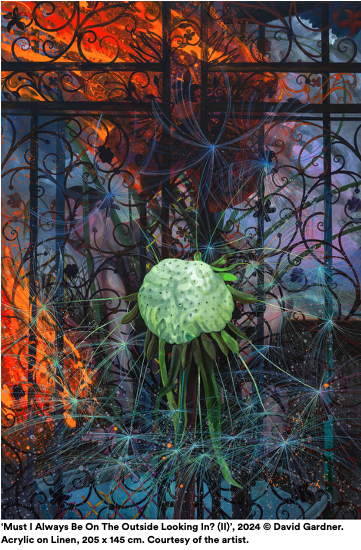
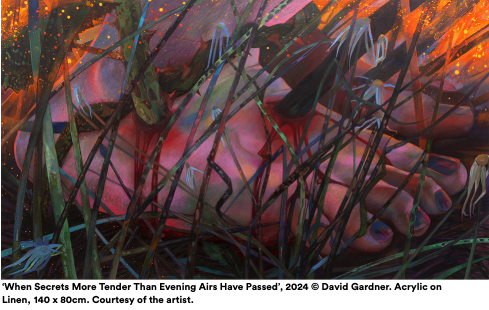
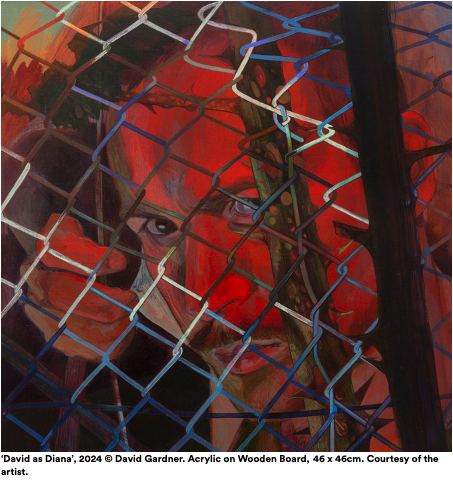
Over the past year I have been challenging myself to work on a bigger scale, using acrylic paints on linen and wooden board. Again, playing around and trying to discover what this medium can do. These mediums dry super quick, and so I can be reactive and intuitive with my colour combinations and layers.
I feel like the charcoal, watercolour, gouache and acrylic have been slowly leading towards working with oil. My next venture in this new year is to start working with oil paints again. The richness, depth, and luminosity of pigment, colour and surface that oil gives will allow my love of colour to go to that next level.
Where do you find the most inspiration for your work?
I love the body, especially the male form, and I will probably spend my whole artistic career trying to capture it.
I love being immersed in the natural landscape, discovering new flora and terrain.
I’m seeking a reconnection between the body and the natural world, both physically and spiritually. I’m very conscious of how as a species we have become so disconnected from the natural world with catastrophic ecological, political, and spiritual consequences.
I’ve been reading Ovid’s Metamorphoses and the story of Daphne and Apollo in particular. This has then led me down some amazing research paths, discovering the Modern Primitive Fakir Musafar, and his Sun Dance ritual, which in turn has led me to researching other ancient rituals that seek a reconnection to our true nature.
A body of work usually starts with research – be it looking through books at the library, visiting the museums and galleries of London and beyond, reading and writing. I will then draw from observation, working from the local landscape, drawing from my own body, working from models at life drawing classes.
This process will then cook together and slowly simmer until compositional ideas begin to flow and form.
I then draw these compositions in notebooks and paper, visualising them, mapping out their layers, line, forms and colour palette. I can usually visualise 5 steps ahead in order to compose the layers of the painting but of course, once the painting begins, chance and magic take over and the painting begins to slowly paint itself.
I paint in my studio in Woolwich. I am an early bird and like to get to the studio early and I will spend a long day there. A 30-minute nap after a late lunch will re-energise me! I recently bought a cassette player and have been playing my cassette tapes whilst I work. Diamonds and Pearls by Prince and the New Power Generation is currently on repeat.
Can you remember the first work of art that you created? What was it and why was it so memorable?
One of the first pictures I remember was a collaborative painting, made whilst I was in reception class at primary school. One of the big kids from final year chose me to collaborate with them. We created a huge landscape that had a giant sun. We stuffed cushions behind the image of the sun, so that it became a 3D relief, rising up from the surface of the picture. It was on permanent display in the assembly hall, alongside the other giant pictures made by other students. I remember the patterns of the cushions we padded behind the sun slowly coming through the fading yellow pigment of the sun over time.
What did winning the ACS Prize mean for you as an artist? How did you use the prize money? How did that help you as an artist?
Winning the Studio Prize has allowed me to expand! I used the Prize to pay for a full year’s studio rent – relieving the burden of increasingly expensive studio rents in London!
It allowed me to have a studio of my own for a full year, with space to stretch out and step back from the works being made. It also gave me the important solitude I need to create.
Since winning the ACS Prize, how has your practice developed? How did the funds provided by ACS contribute to this development? E.g. Purchase of new art materials, additional educational courses, access to workshop space, and research trips.
Having the extra space gave me the opportunity to finally work on an ambitious bigger scale – my most recent painting being 205 x 145 cm. This year, I plan to explore this scale further, as it has begun to take my painting language into exciting new ground.
With the studio rent being taken care of, I invested in new quality paints and surfaces. During 2023, I was working mainly in acrylic paints on linen and wooden board.
I also travelled for the first time in years. I went to the South of France for two weeks to discover, research, and draw from a new landscape. I also painted in Italy for a month, during my stay at the amazing residency at Palazzo Monti. This residency was life changing, I made amazing new connections with fellow artists and curators, and I have expanded my artistic community twofold.
I’d say that the Prize has given me confidence in my practice. It has also expanded my network of fellow artists, curators, and galleries. The team at ACS have been so supportive, and after being invited, I am now a member of ACS.
How are you looking to continue your development following graduation and the assistance of the ACS Prize? What do you have coming up (e.g. exhibitions, residencies)?
My main goal this year is to develop my painting practice into oil paints, working on a new ambitious scale. The aim is to expand my audience and connect with curators and galleries.
I am applying to numerous residencies through the Royal Drawing School alumni residency programme, and I plan to get back into the life drawing room at the Royal Drawing School studio too!