
Wanderer © Joshua Donkor. Courtesy of the artist.
How would you define your work in three words?
Ancestry, family and connection.
What medium do you mainly work with and why?
I tend to work with oil paints and image transfers on board on canvas.
When you look closely at my paintings you begin to see photographs within the background created through different image transfer techniques. These images are provided by my sitters and offer a glimpse into their families, cultures and histories. Depending on the transfer techniques used, they can either leave a clear impression of the photograph or the slightest impression.
These techniques combined with fluid semi-translucent layers of oil paint evoke a sense of memory. Images fade in an out of view, with especially significant images standing out to the viewers whilst some remain so subtle that only the sitter would be able to recognise them.
The use of oil paints also allows me to build up vibrant skin tones within my portraits against the fluid almost dreamlike background; hopefully these techniques help draw audiences into the paintings and the worlds of the subjects.
Where do you find most inspiration for your work?
My family have always been the main inspiration behind my work.

Growing up mixed raced, Ghanaian and English meant that I was exposed to two very different cultures. Seeing and hearing about my parents’ different upbringings, families and cultures was always a massive source of interest for me.
I grew up with access to incredible photo albums that my parents had collated showing images from their respective childhoods and eventual lives together in Ghana and the UK.
These albums became the jumping off place for my paintings. I use the photographs as inspiration for paintings which explore my families’ experiences across different generations and cultures. Both celebrating the love and connection between families and highlighting some of the complexities that exist when navigating life between different cultures and places.
Take us through your working process.
‘Worlds Apart’ depicts a bittersweet moment between my Grandmother “Old Lady” and my cousin Louise when our Grandparents came over to the UK for the first time.
Within this scene my Grandmother is speaking with Louise in the Akan dialect Twi, as Louise looks on appearing totally lost not understanding the language. For me this scene captures both a longing for connection and a sense of disconnection. A feeling well known to many members of diaspora and something me and my cousin often experienced with our Ghanaian Grandparents due to the language barrier.
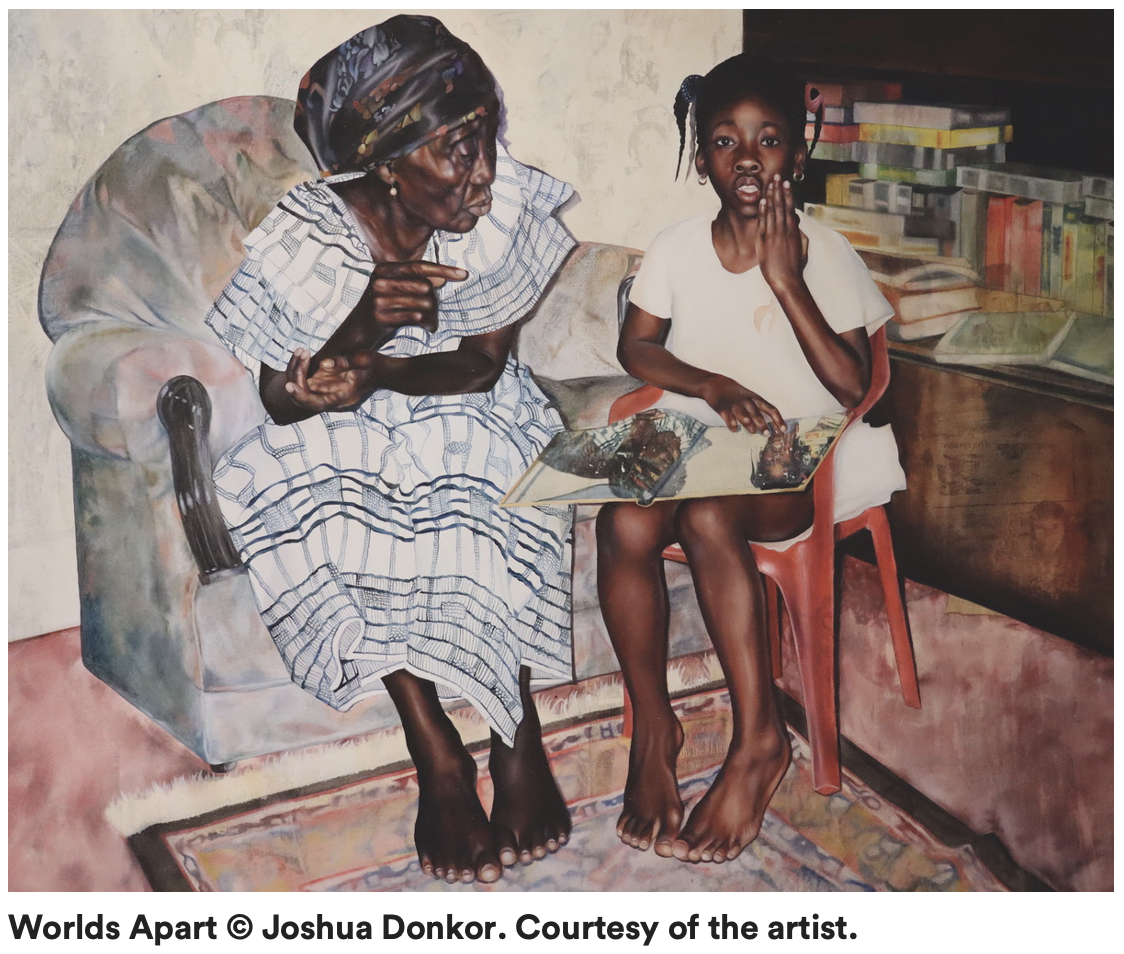
In “Worlds Apart” I surrounded my Grandmother with an array of black and white image transfers capturing moments from her life in Ghana. I then did the same with the drawing of Louise, using photos capturing memories of her upbringing in the UK and journeys back to Ghana.
These images all become obscured when I begin to paint. By using varied layers of translucent and semi translucent oil paint, images become more obscured and some even completely hidden. This plays on the idea of memory with the most significant images standing out while some older images appear more distant and fragmented.
The only parts of my paintings that are fully resolved are the portraits themselves. I tend to build the portraits up with two to three layers of oil paint to ensure that they stand out as the only solid figures within a somewhat fluid and abstracted background.
My hope is that within every portrait I create, you can trace the histories and memories that have shaped the subjects lives.

Can you remember the first work of art that you created? What was it and why was it so memorable?
I can remember some of the first portraits I made, inevitably of my parents when I was very young. But the piece that really stands out in my memory is a portrait of my Dad I made in 2020. It was the first painting I made after graduating and it was the moment in which I felt like my practice was really starting to come together.
The portrait explores my Dad’s connection to Ghana having now spent more of his life in the UK. Within the painting are old family photos capturing his childhood memories of Ghana like gradually fading fragments from his past.
The piece remains my favourite because I feel like it says so much and can be read in so many different ways. It really became the blue print for my work moving forward.
ACS works with a number of universities throughout the UK to educate the next generation of artists about their intellectual property rights. How has ACS helped protect and promote your interests as artists during your career?
This kind of help is invaluable, especially when just beginning to navigate the art industry.

They have also put together professional practice talks through the Artist’s Collecting Society Studio Prize. These talks have allowed artists to meet and ask questions to industry experts working for major galleries and institutions.
These kind of experiences have given me a far greater understanding of my rights as an artist and the kind of opportunities I should look out for an sometimes avoid.
What do you have coming up over the next year?
I was incredibly fortunate to have my first Museum solo show with The Holburne Museum in Bath from January 2025 to May. This was an incredibly special moment, especially having grown up in the city.
Now the focus is purely on being back in the studio and developing new work!
I’m excited to be working on a joint show with Lela Harris which will be opening in Abbot Hall Art Gallery from Sat 11 April to Sat 3 October 2026. This will hopefully feature quite a few new personal works and pieces from my new “Wanderers” series.
To view more works by Joshua Donkor, visit his website here.