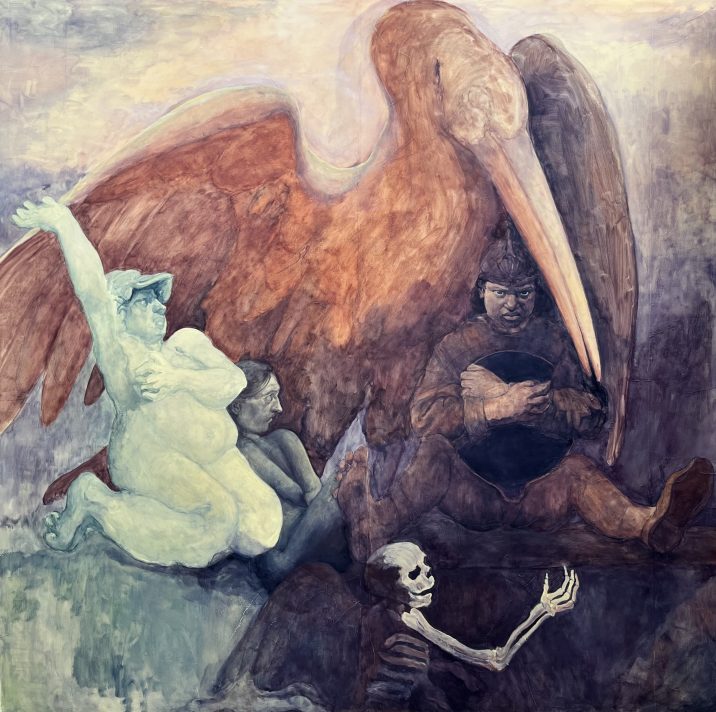
‘Fight/Flight of the Birds’, 2025 © Elena Njoabuzia Onwochei-Garcia. From the series ‘On Planning’. Oil on washi, 239 x 242cm. Courtesy of the artist.
How would you define your work in three words?
Allegorical, ambiguous imagery.
What medium do you mainly work with and why?
I primarily work with washi, pastel and oil. Paper, as a surface for writing, embodies the history of ideas, which is what I draw most inspiration from. I’m also drawn to washi paper’s material qualities: its smoothness, without the grid of a canvas weave, allows oil to seep over it without interruptions. Paper is malleable whilst retaining its form; it can be twisted, cut, and rejoined, which, in turn, allows me to play with the visual resonance of the motifs I draw and use in my compositions.
Where do you find most inspiration for your work?
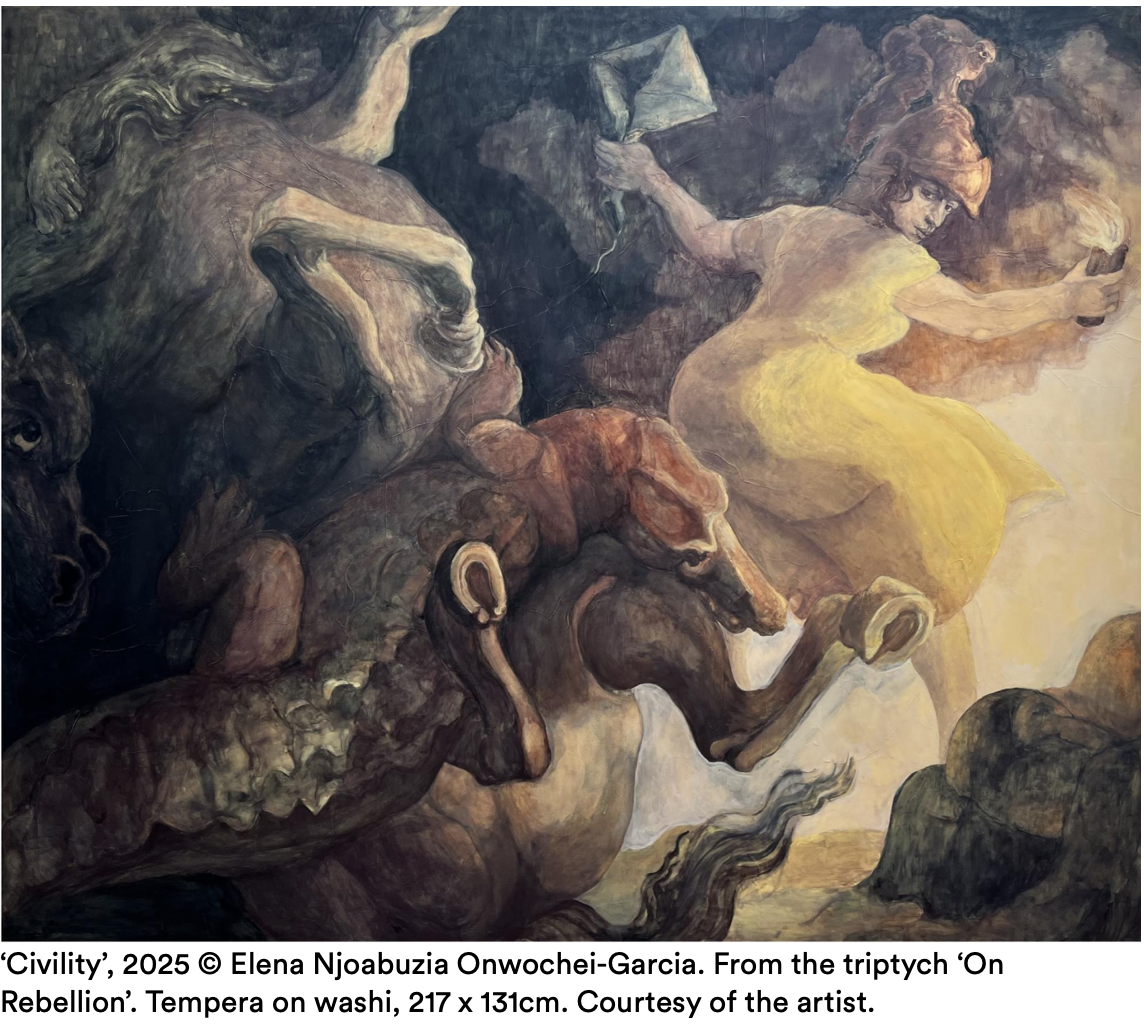
I enjoy researching the different ways these cultural artefacts can be read and understood.
Take us through your working process.
I often begin a project with something that has been niggling away at me, an uncertainty or something I want to understand further. For example, for my ‘Quixotic’ series, I explored which mindset – idealism or realism – is “better”? This approach often aligns with a dissatisfaction or a desire to push an element of my practice forward.
I then research the relevant subjects and explore the ideas while sketching images from my archive. From there, I begin working on compositions, cutting out my drawings and collaging them to construct the bodies and landscapes that form the narrative. Through this process, I work out which elements, often represented through symbols, are motivating or impinging upon the agents in the scene.
Recently, I’ve begun doing this at a large scale by collaging my massive ink drawings to understand how our bodies interact with figures on a monumental scale.
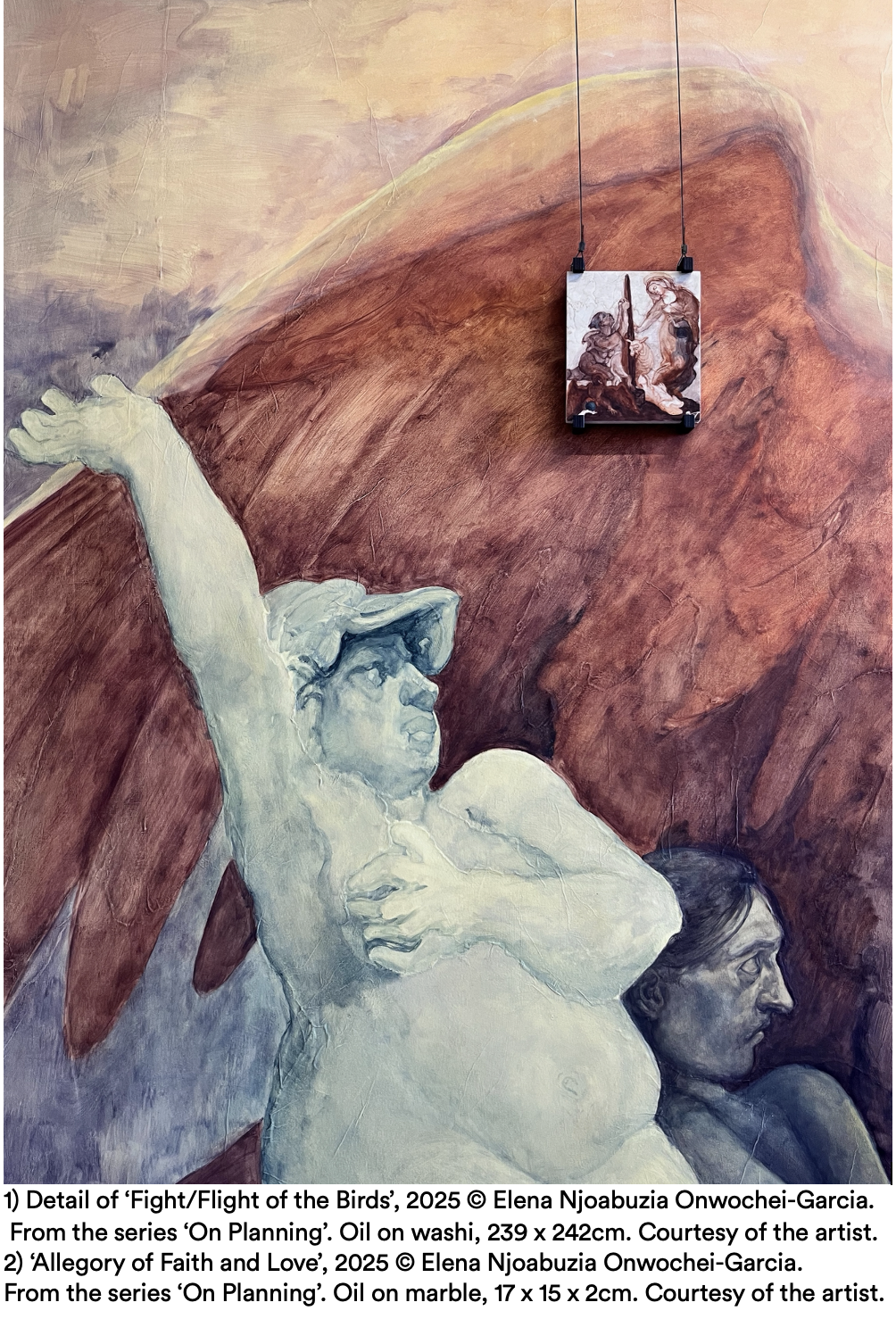
Whilst researching, I often begin shaping up what different elements/stages will be represented on the stone, washi, or cutout.
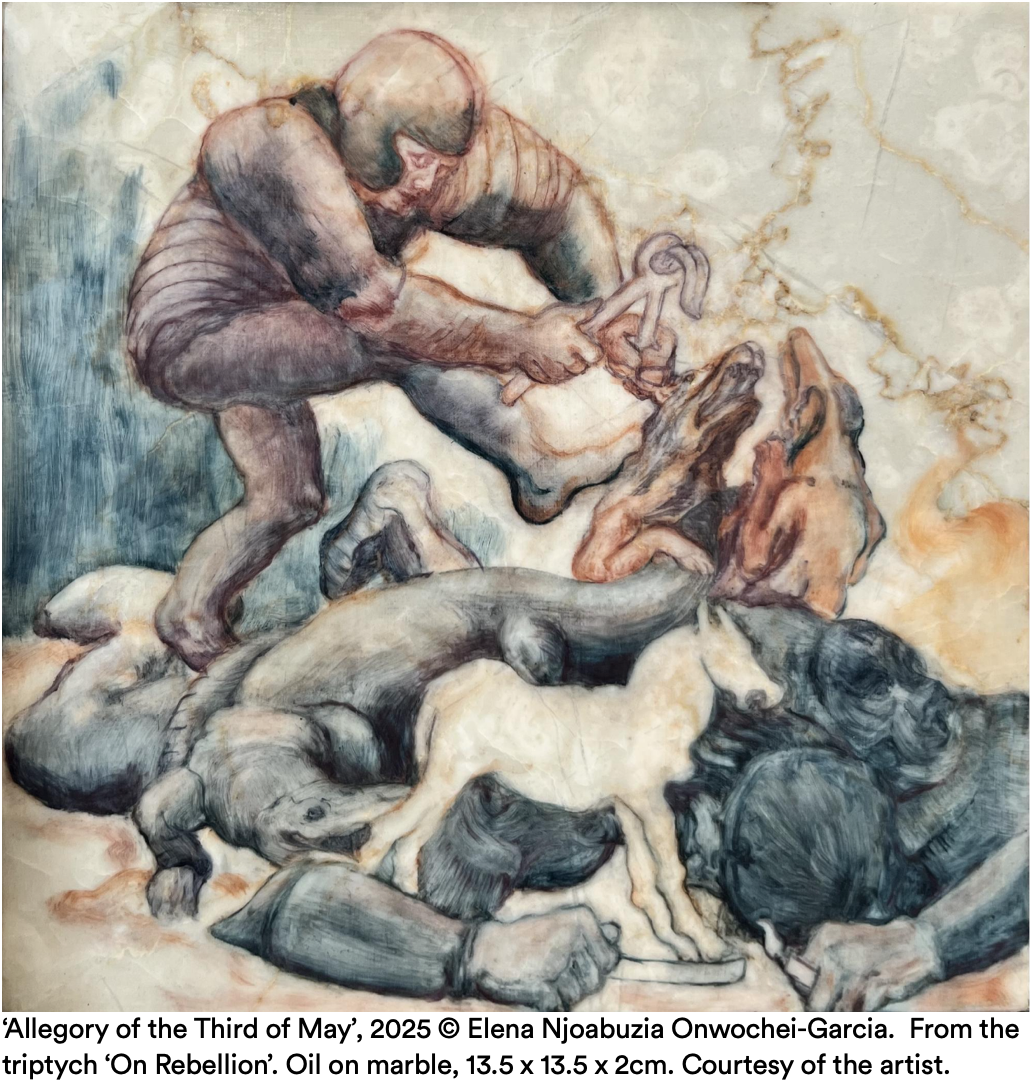
Thanks to the ACS Studio Prize, I was able to develop this technique further, as well as take time to expand the allegorical framework of my installation – adding stone miniatures and washi cut-outs so that viewers read between the three allegorical elements.
Can you remember the first work of art that you created? What was it and why was it so memorable?
As a child, I was playing with those felt boards. I gathered lots of different felt animals, objects and shapes, organised them by colour, and used them to create an image of a tree. It wasn’t really a work of art, but it felt significant because I was creating an image out of many images, and something seemed to click, perhaps only in retrospect. I think its trunk was filled with monkeys, stars and flowers. Looking back, it feels like an early version of the way I now compose images through assembling fragments.
What does it mean to you to win the ACS Studio Prize? How did you use the prize money? How did that help you as an artist?
I used the prize money to fund my studio for a year and to access materials at a scale and variety I hadn’t previously been able to work with, particularly washi. This enabled me to further develop my process of building paintings from cut-out collaged surfaces, so that the surface itself retains and reveals the structure of the original composition.
The support of ACS also strengthened subsequent funding applications and helped give my work greater visibility in London, which has been especially meaningful while working in Glasgow.
What do you have coming up over the next year?
Over the coming year, I’ll be undertaking a research trip to Japan supported by the Artist Network bursary, where I will investigate the production and treatment of washi. Visiting paper factories, master craftspeople and workshops will allow me to further explore the material’s sculptural and compositional potential within my practice.
I will also present a solo exhibition at William Hine Gallery in London, opening during London Gallery Weekend, where I will be showing a new installation of paintings and sculptures.
Alongside this, I have been commissioned to produce a series of paintings for a historic house in England. I was also fortunate to receive a grant from the Elizabeth Greenshields Foundation, which will support a programme of etching workshops and research trips to Madrid and London. During this research, I’ll be studying Renaissance stone painting techniques and Old Master painting innovations, as part of developing a new body of allegorical works.
To view more works by Elena Njoabuzia Onwochei-Garcia, visit her website here.